
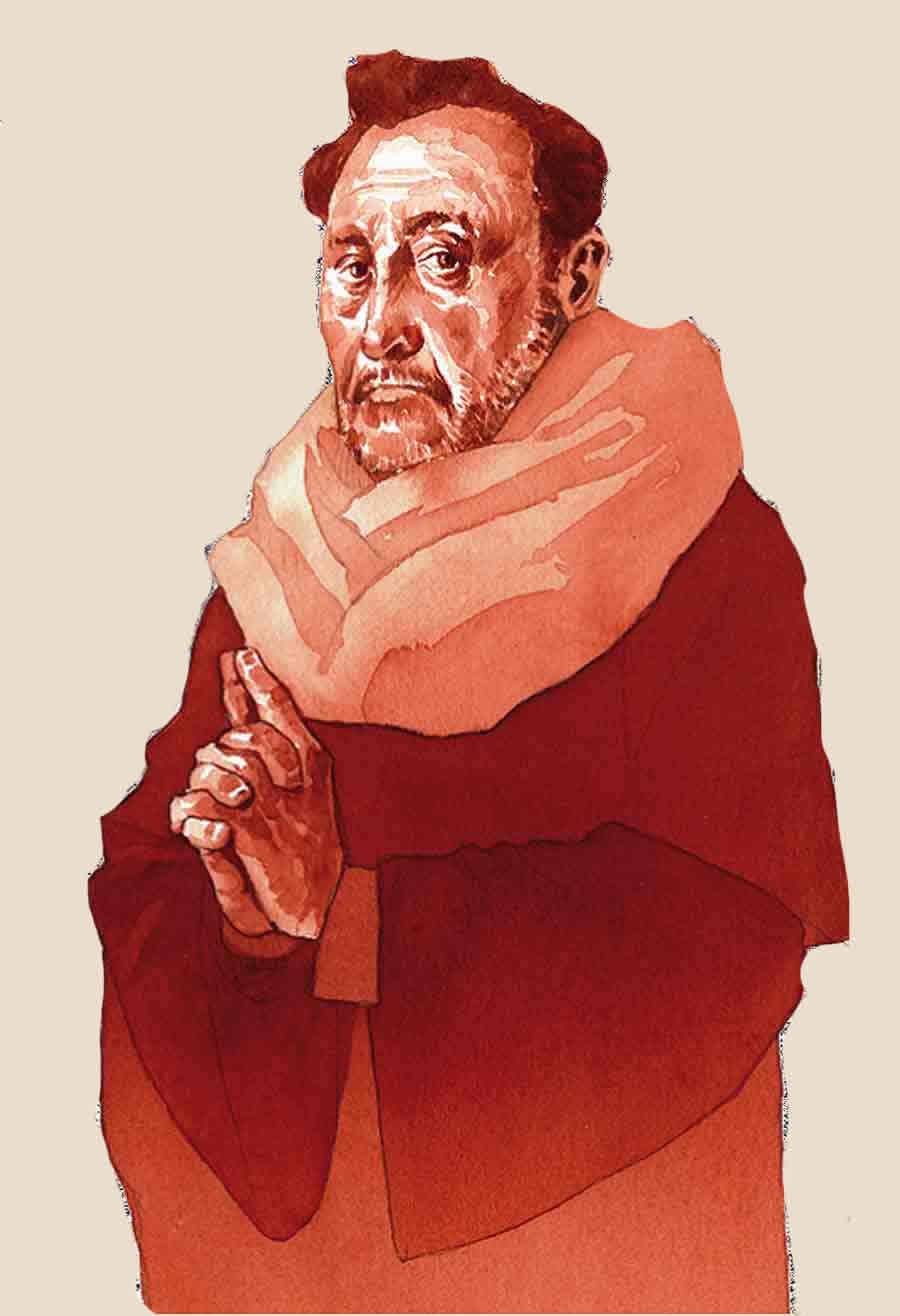
A letter from the Prior Provincial Southern Dominican Province of St. Martin de Porres (dated 1998) on the unfortunate events leading to the martyrdom of Friar Luis de Cancer on the shores of Tampa Bay in 1549.
On the eve of the 21st century, we Dominican friars of the Southern Province of St. Martin de Porres turn our minds to the 16th century to remember one of the pioneering evangelizers in our Order of Preachers — fray Luis de Cancer, O.P. – and his martyrdom in Florida’s Tampa Bay on June 26, 1549.
Considered the Proto-Martyr of Florida, fray Luis de Cancer is the first in a series of Dominican, Franciscan and Jesuit martyr missionaries who gave their lives in bringing the Gospel to the peoples of the Spanish Province of Florida.
Fr. Luis de Cancer de Barbastro, O.P., was among the early members of the celebrated Dominican community in Santo Domingo (in what is now the Dominican Republic) on the island of Hispaniola — a community that called itself “the Holy Preaching” and that included fr. Antonio de Montesinos, O.P., the first defender of the rights of the indigenous peoples of the western hemisphere, and fr. Bartolome de las Casas, O.P., who was proclaimed the Protector of the Indians.
The unique contribution of fray Luis de Cancer is the pacifist approach he both exemplified and advocated for the evangelization of the peoples of the newly discovered continent. This Dominican approach enjoyed great success among the Mayan peoples in Guatemala and southern Mexico. The friars insisted on meeting the people on their own terms and without the presence of armed troops of the Spanish crown.
Information is scant about fray Luis’ origins and early years. Historians debate about this place of birth, though there are some strong indications leading us to believe that he was born in the city of Barbastro, in the Kingdom of Aragon in Spain. Most probably, he entered the Order in the Priory in Huesca, a house of the Province of Aragon established in 1254. One of fray Luis’ earliest chroniclers presents him as a friar of great intellectual ability destined for an academic career. Yet his apostolic zeal as a Friar Preacher moved him to abandon the academic world and become a preacher in the newly discovered hemisphere.
Fr. Luis left his Province of Aragon around October of 1518 to become a member of the newly formed Province of the Holy Cross of the Indies on the island of Hispaniola now shared by the Dominican Republic and Haiti. In 1521, he traveled with Montesinos to open a new priory in San Juan, Puerto Rico, where he became its first prior.
Perhaps the most notable achievement of fray Luis was his role in the pacifist preaching project he began in 1542 in the territory of Guatemala then known as “Tuzulutlán” (the Land of War — because the different Mayan groups of the region were in a constant state of war against any possible Spanish presence).
Dominican missionaries faced the challenge of finding some means to overcome the mistrust against any European, especially with those peoples who had experienced violent encounters.
Aware of the sensitivity of the Mayan peoples for music, they decided to use song as a first means of contact. The friars translated the content of their preaching into a rhythmic poetic form using the different languages of the region and employing images and idioms from the indigenous cultures.
A contemporary chronicler tells us about fr. Luis de Cancer’s exceptional ability to master the different Mayan dialects of the area. A document of his day accredited fray Luis as the composer of Christian canticles in the quiché language of Sacapulas and the q’eqchi’ of Cobán.
After having spread their songs through some merchant Mayans who had free access to the area, and learning of the positive acceptance of their message, it was decided that not all the missionaries, but just one, should go as an ambassador.
This role of Ambassador for Christ fell to fr. Luis de Cancer, who willingly accepted the challenge, even though he was aware of the high risk to his life. The success of his preaching opened the way for the mission to the entire Land of War — which soon was referred to by Bartolome de las Casas, who became bishop of nearby Chiapas, as “LaTierra de la Verapaz” — the Land of the True Peace. Thus, this pacifist approach to evangelization had proved itself a valid and effective means.
Cancer recruited the Dominicans Gregorio de Beteta, Diego de Tolosa, Juan García and another known as Brother Fuentes. After leaving Veracruz , they reached Havana in 1549. There, they took an Aboriginal convert, “Magdalena”, as a highly recommended interpreter. They left for Florida in a caravel captained by Juan de Arena. Despite warnings about the Gulf Coast, Arena took them south of Tampa Bay , just a few miles from the landing sites of previous expeditions. There they encountered a group of natives, apparently peaceful and receptive, who told them about the large towns of the Tocobaga chiefs around the bay. Sensing good faith, the expedition was divided: Magdalena, Diego de Tolosa, Brother Fuentes and a sailor whose name has not been preserved followed the indigenous people on a half-day trip by land and Cancer returned to the caravel to join them there. . 7
The caravel arrived in Tampa Bay on June 23, 1549 and only found Magdalena and a group of Indians. Magdalena, now “very changed” was wearing Indian clothes and she told Cancer that she had convinced the local chief that the friars were peaceful and that the Spanish were now her guests. Cancer and the others returned to the caravel that afternoon, where they found Juan Munos, a sailor who had been enslaved by the Indians years ago and had managed to escape. Munos said that Tocobaga had killed the friars and enslaved the sailor. Beteta and García wanted to flee and sail to the east coast, but Cancer refused to leave a land “blessed by the blood of life” of his compatriots. The next day, the three men rowed to shore, where they saw a group of hostile Indians. Cancer left the boat and waded to shore where he was captured and beaten to death.
In 1549, he arrived at Tampa Bay with the objective of peacefully converting the Indians of the region to Christianity through their native languages. On meeting the Tocobaga he proclaimed: “He oça uluata”, meaning “We are good men”. Dressed in his habit and carrying a cross, he approached the shore. As soon as he reached land, the Indians surrounded him and began beating him with macanas until he was dead, according to an account by his colleague Gregorio Beteta.
 FLORIDA MARITIME